
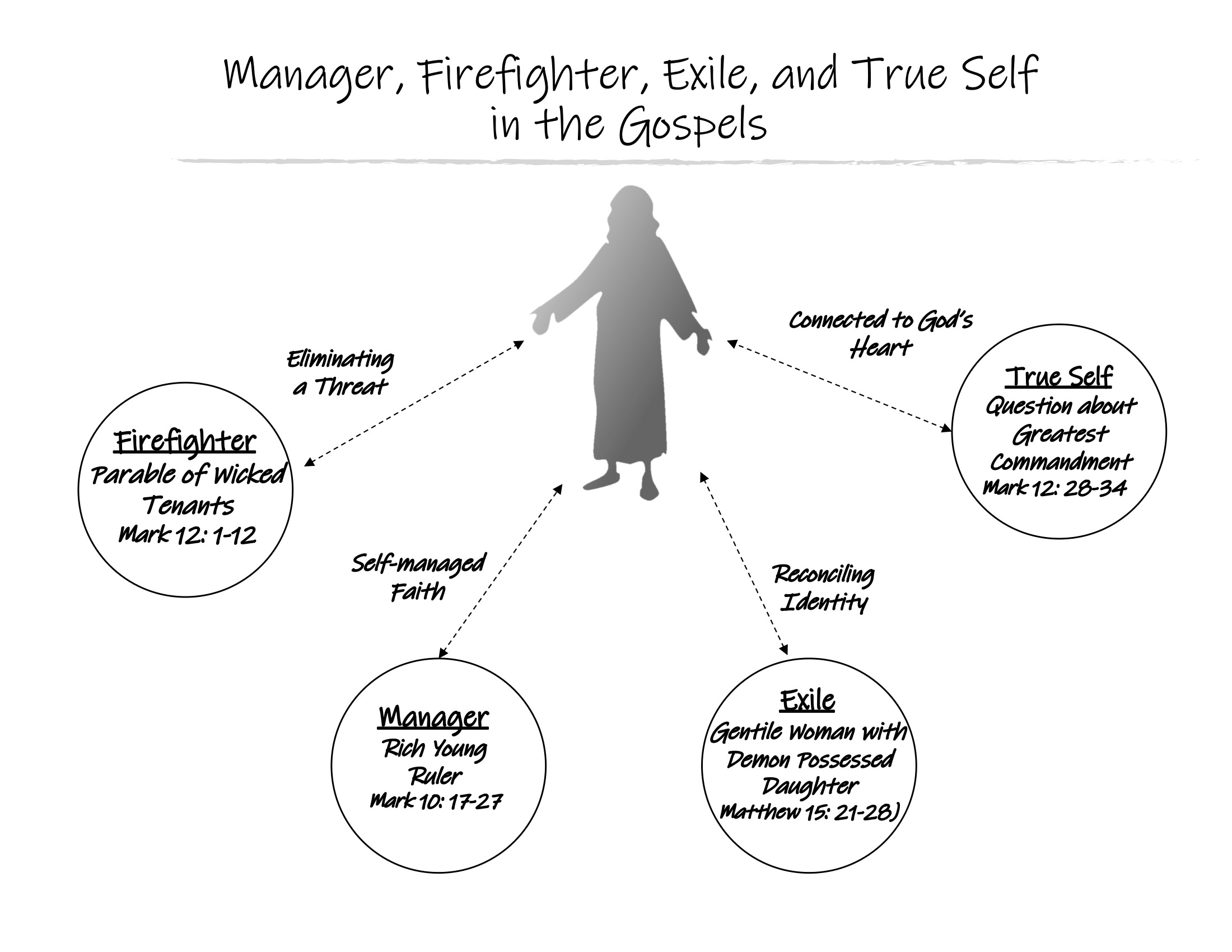
The Bible does not use the terms manager, firefighter, exile, and true self. But we can find examples of them in Scripture because they have always been part of human nature. In the Gospels, we often see Jesus working with one of these four mindsets in a person’s life.
Managers in Scripture
The Rich Young Ruler, Mark 10:17-27: The rich young ruler had lived his life entirely focused on self-management and achieving goals. This means his life was probably dominated by an internal manager who became a false self. Managers focus on accomplishing things rather than being in touch with life. Manager-dominated people often suppress their true selves, the side of them who can live in touch with the authenticity of life and find love and communion with God. Jesus tried to draw this realization out of the young man by listing the commandments focused on self-management: Do not murder, do not commit adultery, do not steal, do not bear false witness, do not defraud, honor your father and mother. The young man could obey all these commandments without possessing a living connection to the heart of God. He came to Jesus because he saw eternal life as yet another goal to achieve, rather than understanding that eternal life is found in communion with God. So Jesus invited him to remove everything he was self-managing from his life and come and follow him. But deeply entrenched managers have trouble relinquishing control. The young man apparently had suppressed his true self, and his manager-self, who focused on accomplishments, found more security in self-effort and wealth than in the person of God. His manager-self would not relinquish control.
Religious Managers—Question about Paying Taxes, Mark 12:13-17: The Pharisees built their religious lives around managing behavior. One of Jesus’s purposes was to set people free from the idea that self-management produces eternal life. When the Pharisees asked Jesus if it is lawful to pay taxes to Caesar, they were placing more importance on religious self-management than living out of hearts that were in communion with God (like David). Jesus’s answer was designed to reveal the truth that behavior related to this world is not the key to knowing the heart of God.
Religious Firefighters in Scripture
The Parable of the Wicked Tenants, Mark 12:1-12: Firefighting often misconstrues other people, rather than the condition of our own hearts, as the problem that needs to be fixed. One of the problems with firefighting is that it often does not consider the welfare of self or others, as long as it can put out the fire that is threatening us. The chief priests, scribes, and Pharisees saw Jesus as a threat to their power. They wanted to extinguish this threat. Jesus pointed this out by telling them the Parable of the Wicked Tenants. When they realized they had been exposed, their firefighting doubled down, and they reacted with wanting to arrest and kill Jesus. Obviously, that kind of firefighting came from hearts that were out of sync with God.
Peter’s Rebuke of Jesus, Matthew 16:22: Peter went into firefighter mode when Jesus first revealed that he must suffer and be crucified. Peter pulled Jesus aside and rebuked him for saying such a thing. Firefighting only wants to eliminate pain. The pain from the idea of losing Jesus kept Peter from pressing into what Jesus said to understand it. Peter’s impetuous actions were designed to ease his pain rather than understand the will of God. Firefighting often prevents us from patiently engaging with the greater truths that need to govern our lives.
Exiles in Scripture
Exiles carry our deepest needs for healing. Jesus targets many inner exiles in Scripture, usually restoring their awareness of their own dignity and value. The woman at the well (John 4:7-38) had exiled herself from the presence of other women and most likely was carrying severely damaged self-esteem in her broken (or exiled) parts. The woman caught in adultery (John 8:1-11) may have sinned because an inner exile needed to feel seen, accepted, and loved.
The Canaanite Woman (Matthew 15:21-28): Perhaps my favorite is the Canaanite woman who asked Jesus to deliver her daughter from a demon. Jesus draws out her damaged belief in self by saying, “It is not fair to take the children’s food and throw it to the dogs” (15:26). I do not believe Jesus is calling her a dog. The God I know would never do such a thing to one of his children.
God sees the heart with complete transparency. Jesus sees and wants to heal her broken heart as well as deliver her daughter. So he draws out her damaged identity while confirming the deep faith he sees in her true self. When her true self responds in faith, Jesus calls her “woman,” a term of dignity. You could paraphrase the interaction as, “You think you are a dog compared to others, for this is the way you have been treated. You are not a dog; you are my daughter. Daughter, I affirm you. Go in peace, your child is free.” I believe Jesus healed a wounded mother and a child, both of whom were equally precious as his children.
The True Self in Scripture
The Great Commandment, Mark 12:28-34: The true self is the part of us that most clearly sees the heart of God and the heart of others. In this passage, Jesus answers a scribe’s question about the greatest commandment by saying loving God and loving others is the highest level at which we can live. This scribe’s true self was clearly part of his faith. Jesus brought this out, telling a man steeped in a tradition of religious self-management and legalism, “You are not far from the kingdom of God.” Jesus was speaking to the scribe’s true self.
The Perfectly Balanced Heart
The Temptation, Matthew 4:1-11: Jesus was the perfect balance of healthy manager, healthy firefighter, and true self. Satan believed that if he could throw this balance off and get Jesus to live first out of self-management or firefighting, he could break the strength of his communion with God. If he could do this, he could supplant the person of God in Jesus’s life with himself.
Each time Satan tempted Jesus, he began with, “If you are the Son of God.” This phrase attacks Jesus’s identity. It is the type of attack that could aggravate or create an exile. In each temptation, Satan tempts Jesus to respond to his personal attacks with a suggestion that would base Jesus’s behavior in self-management rather than the inner voice of his Father. He begins with a manager, or possibly firefighter mentality, Jesus you are hungry. Extinguish your hunger by using your powers for yourself rather than the glory of God. Command these stones to become loaves of bread!
Satan then moves to religious self-management by tempting Jesus to test God’s protection over his life. Throw yourself down from the temple. Prove the Word of God through your behavior rather than following the Word of the God in your heart!
The final temptation went to the heart of Jesus’s mission. He offers Jesus a way to fulfill his mission without the cross. Jesus, I know you don’t want to go through all that pain. I have a solution that will prevent all this pain. I’ll give you all of the people of the world, in every kingdom, if you only bow down and worship me. Firefighting thinks only of self, not the good of others. Jesus knows that putting himself and others under Satan’s authority is to live under immense evil. Jesus’s manager and firefighter modes (think left brain) were healthy. They were managing his true self, who lived in perfect harmony with God, rather than damaged exiles. This made Jesus impervious to all of Satan’s temptations. The goal of all inner healing is to live in sync with our true selves, informed and guided by the indwelling presence of God.