
How Does the Heart Become Broken?
Broken parts of the heart form mostly during our childhood when our brains are still developing. Prior to age 13, we are dominated by the emotional and relational parts of our brains (think right hemisphere). Our cognitive brain (think left hemisphere) does not fully mature until around age 25. We find that most parts of our heart that become stuck in the past do so before about age 20. After age 20, new wounds and trauma tend to exacerbate the damage we are already carrying from our childhood.
Let’s illustrate how broken parts formed with Trudy (not her real name) whose childhood was characterized by personal devaluation and emotional neglect. Think of the checkerboard below as the present day and the space below as the past. Trudy has a part of herself that is stuck in the wounds of her childhood, illustrated by the girl in the box below the checkerboard.
One evening when Trudy was about five, she and her sister were playing a game of tag with her father in the backyard. Trudy was excited. Dad rarely played with the children. Expecting her dad to follow and feeling full of life, she began to run. After a few minutes, she noticed he was only chasing her sister. Try as she might, she could not find a way to get his attention. She decided to run out of the backyard, hoping he would see her leave and come after her. She turned around only to see him catch her sister, fall to the ground, and gleefully start tickling her.
A mild chill ran through her little body. Something she had feared felt true. She was less important to her father than her sister. Over time, a long pattern of incidents from her dad devalued Trudy and put her sister on a pedestal.
Our hearts carry three primal needs. We need to feel loved for who we are, valued for who we are, and that we are enough for the life that is in front of us. When these needs are not met, whether because of neglect or trauma, part of our heart becomes stuck in the emotions and beliefs we carried at the time the wound formed. On this afternoon, that part of Trudy’s heart became stuck in the felt reality of being less valued than her sister. Over time, without thinking about it directly, her heart came to feel that if she were less valuable than her own sibling, she must be less valuable than the rest of the world as well.
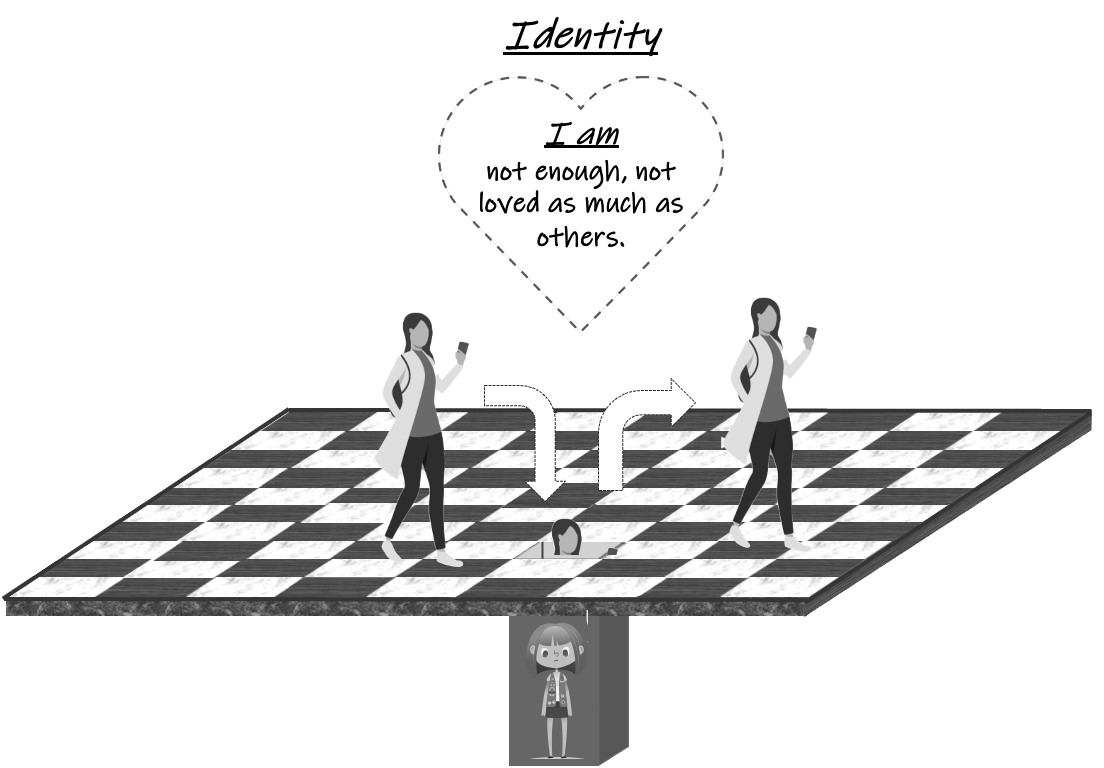
Because part of Trudy’s heart is stuck in the emotions and beliefs of her five-year-old self, she is now carrying what is commonly called an inner child. Now at age 36, Trudy is a pharmacist. She can show up for work in a perfectly good mood, feeling joyful and happy. Then something that feels roughly similar to her childhood happens. She may feel on the outside of a close friendship between two coworkers, or her boss may show someone favor over her. Instantly, it’s as if she fell into a box where the emotions and beliefs of her past become her present reality. She finds herself vying for attention, a bit like a child who wants to be included. She says things her adult self would not normally say. She cannot find a way to silence the inner voice of this wounded child and get back being the happy adult who came to work this morning.
Trudy’s life has become a repetitious cycle. She experiences the same emotional struggles over and over again. On a bad day, she can sink into depression or hopelessness, or she may seek comfort in bulimia. It all depends on the severity of her triggering.
But when Trudy settles down, she comes back to her well-adjusted adult self. It feels as if those childhood wounds no longer exist. She may look back at something she said earlier and think, Why did I say those things? I don’t feel that way at all now! What makes me do those things? When she is not triggered, she feels like a different person.
Trudy works on self-improvement, memorizes Scripture, and tries self-help projects. She can feel she is getting stronger only to find herself blindsided by another triggering that she felt she was mastering. No matter how hard she works, she cannot stop this cycle of triggering in her life.
This is the biblical condition of the broken heart, or double-mind. Two parts of her heart are living in different realities. One is a well-adjusted adult, the other is a wounded inner child. This is why we have sayings like, There is a side to a person that can come out, You don’t seem like yourself today, Something came over me and I felt like a different person, I was beside myself with anger, and more.
But there are more than two parts of Trudy. Throughout our childhood, multiple incidents can cause these wounds to form. The Old Testament’s view of this is more like a shattering than a division into only two minds. Double-minded should be thought of as contrasting mindsets, not two minds. Therefore, it is always more accurate to say we have inner children rather than an inner child. Each part is stuck in its own circumstances of feeling not loved, not valued, or not enough. Each one brings a different part of our past into our present. Sometimes we are fully adult, sometimes we are trapped in the “box” of an inner child. Sometimes several “boxes” are active just below the surface.
In Isaiah, as God speaks of Israel’s return from their exile to Babylon, he uses metaphors that speak not only of their physical return to Israel, but of their wounded hearts and the healing God wants to do in them. In Isaiah 42:22 he says, “But this is a people robbed and plundered; all of them are trapped in holes and hidden in prisons.” That is what the broken pieces of the heart are. They are like holes, holding imprisoned parts of ourselves called exiles that need to be set free.
The degree to which our parts affect us depends on the intensity of their wounding. Some are relatively easy to manage and heal. Others can carry devastation so deep that it is difficult to get near the wound without self-protection kicking in and blocking access to that part of our heart.
Each part of us, no matter how misguided in their behavior, is seeking something good. They are all trying to find a way to feel loved, valued, and/or enough as a person. Healing is a matter of meeting God in a way that changes the felt reality in which these parts of ourselves live.
Getting the Full Picture
For every wounded inner child, we instinctively develop other parts that protect, hold coping mechanisms, and manage life around our wounds. Those parts can be very powerful and can grow strong enough to dominate our lives. If we do not learn to recognize and work with these parts of ourselves, we may never reach the deepest and most powerful wounds of some of our inner children. To learn about the rest of the landscape of the broken heart, see our article The Four Modes of Human Functioning.